
How to Check Criminal History in Zapata County
No single county database contains the full trail. Start with the event and its likely court. Felony filings belong with the District Clerk for the 49th District Court. Class A and B misdemeanor files belong with the County Clerk's criminal counter. A fine-only Class C matter, failure to appear, or capias pro fine may remain with one of the four justice courts. A current jail question goes to Regional Jail or the sheriff's published VINELink channel. The Texas Department of Public Safety adds a statewide public view of reportable convictions and deferred adjudications, but it does not replace the local file.
Gather a full name, date of birth when lawfully known, spelling variants, an arrest date, and any cause or booking number before calling. Those details help the custodian separate similar names. Then follow the record rather than assuming every system should match at once.
- Identify whether the question concerns custody, a filed case, or statewide conviction history.
- Call the correct Zapata County clerk, jail, or sheriff channel and ask which identifier will locate the record.
- Search the official state portal when a statewide comparison is useful.
- Match several identifiers and confirm the hit with the office that created the record.
- Request a certified court copy or fingerprint personal review when identity or accuracy matters.
The official Zapata County gateway is the starting point for local office pages and current routing. Its layout is shown below so a reader can recognize the county source.
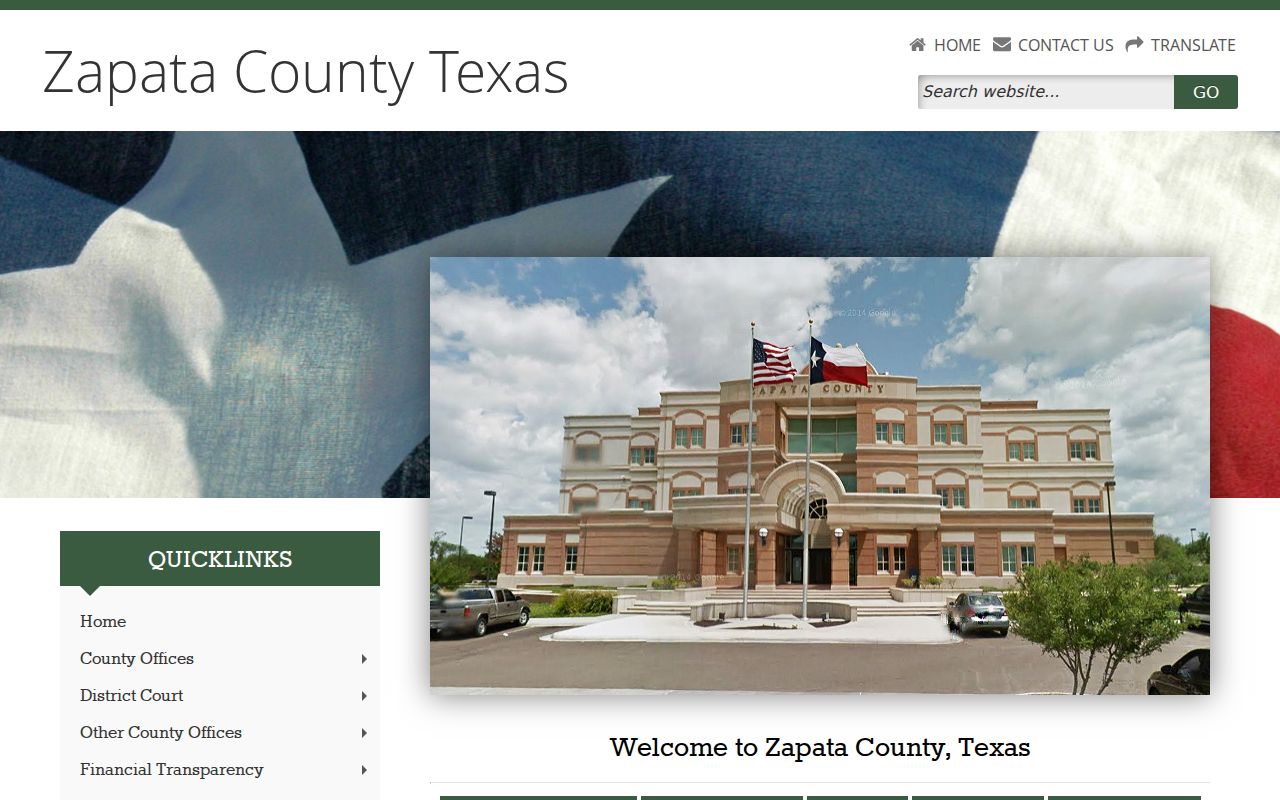
The gateway does not combine criminal records into one search. It leads to the offices that hold each part.
Zapata County Criminal Record Counters
The Zapata County Courthouse at 200 E. 7th Avenue concentrates much of the local justice system, yet its counters do different work. The District Clerk at 956-765-9930 keeps felony filings for the 49th District Court. The County Clerk criminal counter at 956-765-9915 keeps Class A and B misdemeanor files. Justice of the Peace Precinct 3 is also in the courthouse, while the other three JP courts have separate locations. Calling the wrong counter can produce a truthful no-result even when another court holds the matter.
District Clerk
200 E. 7th Ave., Zapata, TX 78076
956-765-9930
49th District Court felony files
County Clerk
200 E. 7th Ave., Zapata, TX 78076
956-765-9915
County Court Class A and B cases
Sheriff's Office
7th Avenue and Hidalgo Boulevard, Zapata
956-765-9960
Reports, warrants, and jail routing
Public hours and suite-level directions were not published in the research. Confirm access, copy charges, and the right counter before travel.
Official Texas Background Checks
The Texas DPS Criminal History Conviction Name Search gives the public a name-based view of eligible Texas convictions and deferred adjudications reported to DPS. It requires an account and prepaid credits. Each search credit costs $1, including a no-match result. Opening more than one matching rap sheet from the same search does not consume another credit. Because names can collide and local reporting can lag, treat a match as a lead that must be tied to identifiers and the originating court.
The official search screen below shows the state entry point and helps distinguish it from private lookup products.
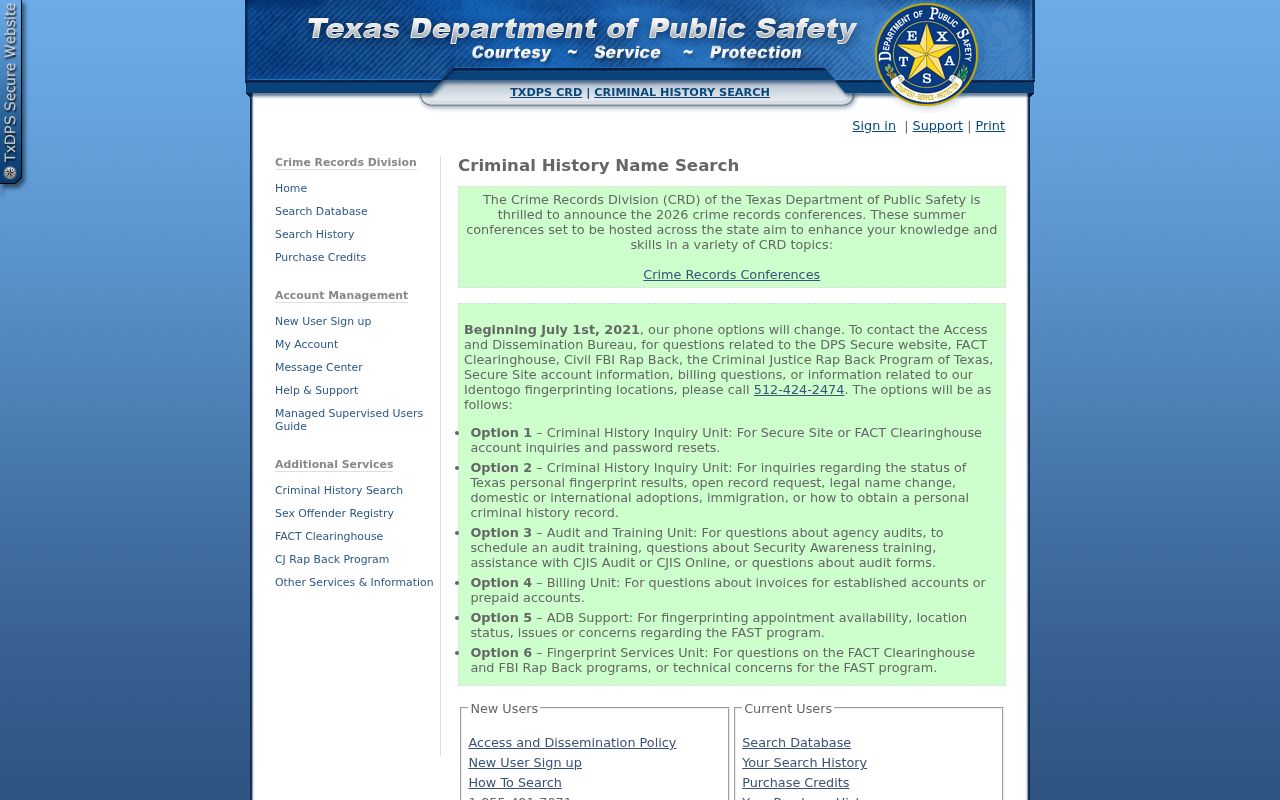
DPS search results are statewide summaries, not certified copies of a Zapata County criminal case.
| Official product | Scope | Published charge |
|---|---|---|
| DPS online name search | Public Texas convictions and deferred adjudications | $1 per search credit |
| DPS offline name check | Public Texas record product | $10 |
| DPS fingerprint personal review | Identity-matched Texas history | $15 plus $10 FAST capture |
| FAST hard cards | Two fingerprint cards | $20 |
| FBI Identity History Summary | Subject's federal identity history | $18 direct, plus capture costs |
Zapata County DPS Search Fields
The DPS public search asks for a last and first name. A middle name and date of birth can narrow results. Its matching process may broaden from the full name to first and last name, then use birth month and day. A result shows what matched and ranks likely candidates. Search history remains in the account for three years, though returned records should still be saved. Offline records may move to manual processing through the portal Message Center.
| Field | Required | Use |
|---|---|---|
| Last name | Yes | Primary surname match |
| First name | Yes | Pairs with surname |
| Middle name | No | Narrows the first pass |
| Date of birth | No | Helps separate similar names |
| Multi-Entry | No | Queues more than one search |
The DPS search support page explains matching, credits, refunds, and help channels. The captured support view appears here.
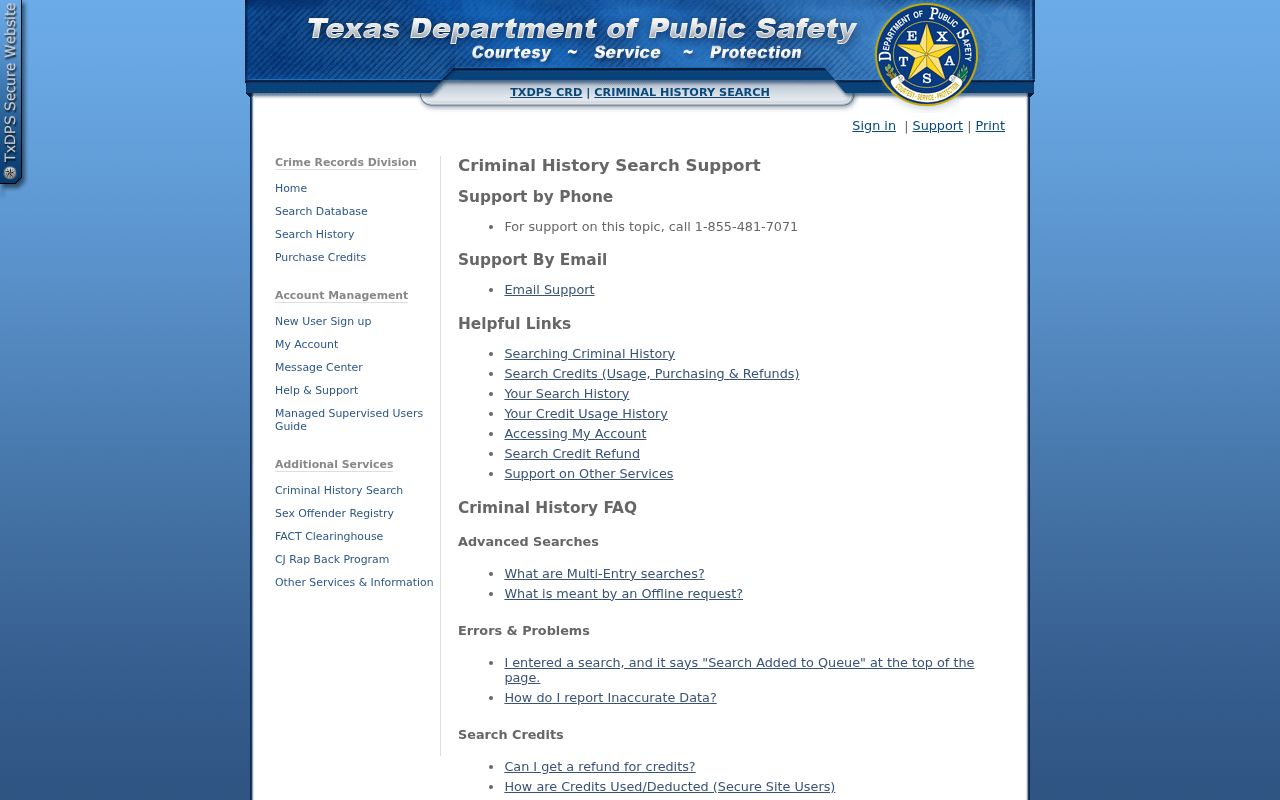
Portal support can explain the product, while the local clerk must confirm the Zapata County disposition behind a hit.
Types of Criminal Records in Zapata County
A single event creates several files. The arresting agency writes the incident and arrest report. The jail records intake, holds, bond, and release. The prosecutor decides what to charge. A court clerk then preserves the complaint, information or indictment, docket, orders, and judgment. DPS builds a fingerprint-linked Computerized Criminal History record from reportable data sent by those agencies. Each source answers a different question, and none should be treated as a complete substitute for the others.
- Arrest and booking records: show allegations, processing, and custody, not guilt.
- Criminal court files: show filed charges, hearings, pleas, rulings, and disposition.
- DPS history: shows eligible public Texas convictions and deferred adjudications reported to the state.
- Warrant records: belong with the issuing court and executing agency, subject to access limits.
- Supervision and registry records: come from the court, CSCD, TDCJ, parole, or DPS registry according to purpose.
Crash reports add another split. The TxDOT CRIS purchase system supplies qualifying Texas crash reports, while any linked criminal charge remains with the court.
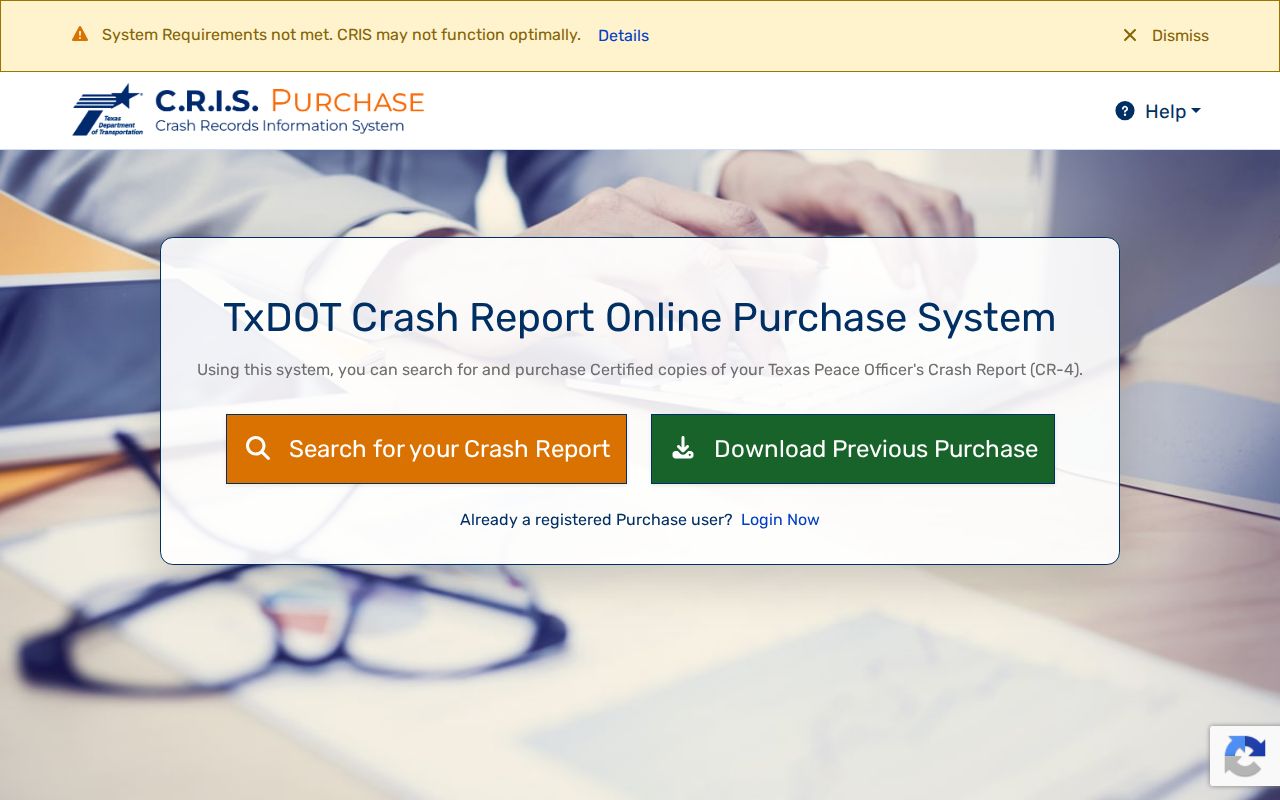
The CRIS screen illustrates why the report source and criminal case source may differ after one highway event.
Zapata Official Records Search Warning
The County Clerk's polished Official Records Search is easy to mistake for a criminal docket. It is not one. Its fields focus on recorded instruments through grantor, grantee, document type, document number, subdivision, date range, and OCR text. Those are useful property and official-record index fields. They do not search the County Court's criminal case file or the District Clerk's felony docket.
The official-record interface shown below is a valuable visual check before entering a name.
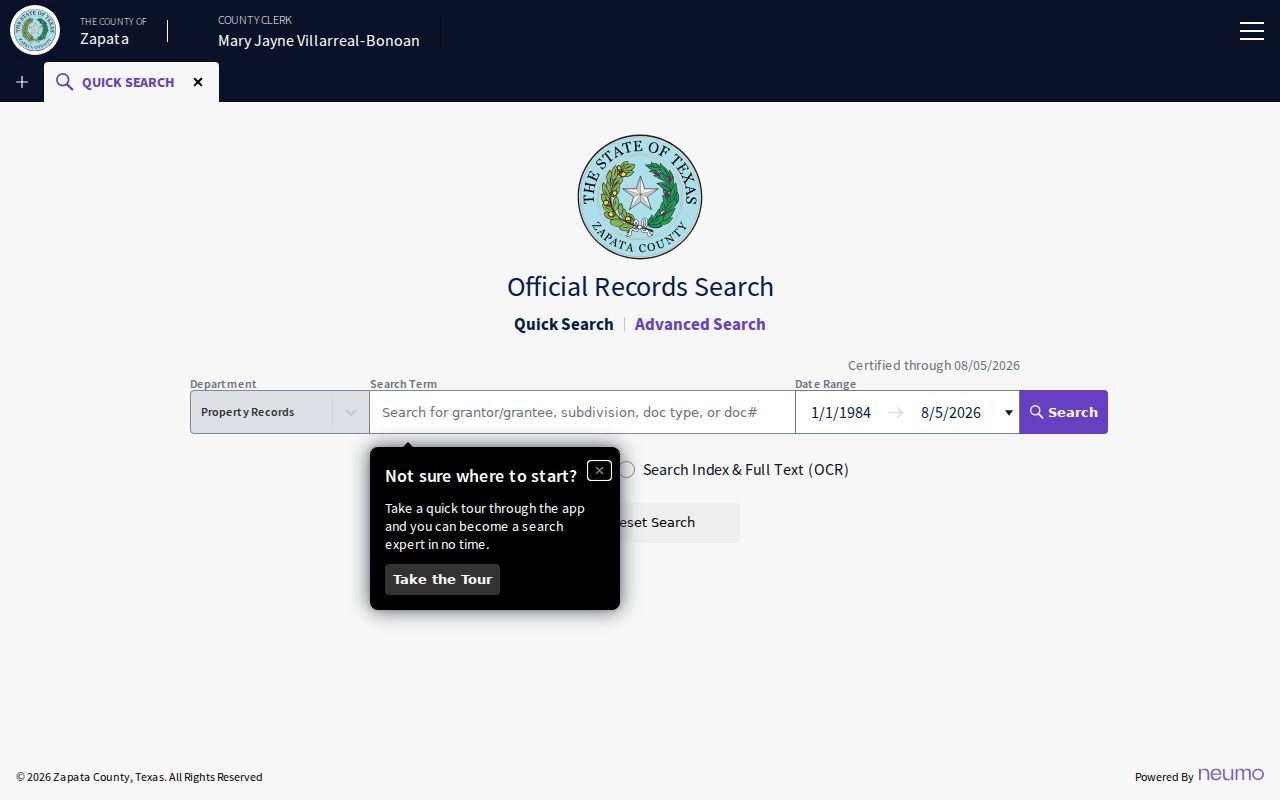
For a criminal cause, call the correct clerk and ask whether re:SearchTX shows that court's public data.
Note: A no-result in the recorded-instrument index says nothing about a Zapata County criminal court record.
What a Zapata County Criminal Record Shows
A Texas CCH record starts with reported identity data, aliases, date of birth, State Identification number, and fingerprint linkage. An arrest cycle can list the arrest date, agency, tracking number, and arrest allegations. Prosecutor and court segments can show accepted charges, cause number, court, outcome, and sentence. A Zapata County court file is richer in another way. It may include the charging paper, bond papers, attorney appearances, settings, motions, pleas, orders, judgment, costs, and available documents.
| Name and identifiers | Reported names, aliases, birth information, SID, and fingerprint links where available. |
|---|---|
| Arrest and booking | Date, agency, tracking or booking number, allegations, custody, holds, bond, and release. |
| Filed charge | Offense description, statute, degree, and complaint, information, or indictment. |
| Disposition | Pending, dismissed, acquitted, deferred, convicted, no-billed, or transferred status. |
| Sentence | Confinement, fine, costs, restitution, or community supervision reflected in the judgment. |
| Limits | Sealed, juvenile, victim, and sensitive identifiers are withheld or redacted. |
A booking charge can change before filing. The court's final judgment is the best source for the judicial result.
Zapata County Custody Record Paths
Zapata County publishes no online jail roster. For a fresh booking, call Regional Jail at 956-765-8615 and check VINELink through the sheriff's official page. The separately listed Women's Jail line is 956-765-9981. Ask for the booked name, booking number, facility, current holds, bond terms, and whether transfer is pending. Do not send funds based on a third-party directory or an old vendor name. A release event in VINE can also mean transfer rather than physical release.
After transfer to a Texas state prison, use the TDCJ Online Inmate Search. Federal sentenced custody belongs in the BOP locator, while a new federal defendant may be held under a U.S. Marshals arrangement. The correct sequence is local jail, state or federal locator if transferred, then the court docket for the legal basis.
Note: The official Zapata County Sheriff page documents VINELink, but no sheriff app, booking log, or mugshot gallery was verified.
Public Access Laws for Zapata County Criminal Records
The Texas Public Information Act governs requests for governmental records, but it does not erase confidentiality. Ask the agency that holds the exact item. Sheriff reports and booking sheets go to the sheriff, felony files to the District Clerk, misdemeanor files to the County Clerk, and fine-only matters to the issuing JP. Government Code section 552.221 requires prompt action. The often-cited ten-business-day rule usually concerns an agency's request for an Attorney General withholding decision, not a promised delivery date.
Key Texas laws:
Government Code Chapter 552 permits public requests while allowing lawful redaction and withholding.
Government Code Chapter 411 controls criminal-history access and public conviction data.
Code of Criminal Procedure Chapter 66 assigns criminal-history reporting duties.
Code of Criminal Procedure Chapter 55 sets expunction eligibility and process.
Code of Criminal Procedure Chapter 62 governs sex offender registration and public data.
Active investigation material, juvenile records, victim identities, medical data, driver-license numbers, and security-sensitive jail information may be withheld or redacted.
Correcting Zapata County Criminal History
When a DPS name result appears to belong to someone else or lacks a disposition, use an identity-based process. A FAST fingerprint personal review is more reliable than repeating a name search. The applicant needs the correct service code, acceptable identification, and an appointment through IdentoGO. No permanent Zapata County enrollment site was confirmed, so the booking system must supply the current mobile or nearby location.
The official IdentoGO enrollment portal begins with the service code or reason, then shows locations and appointment choices.
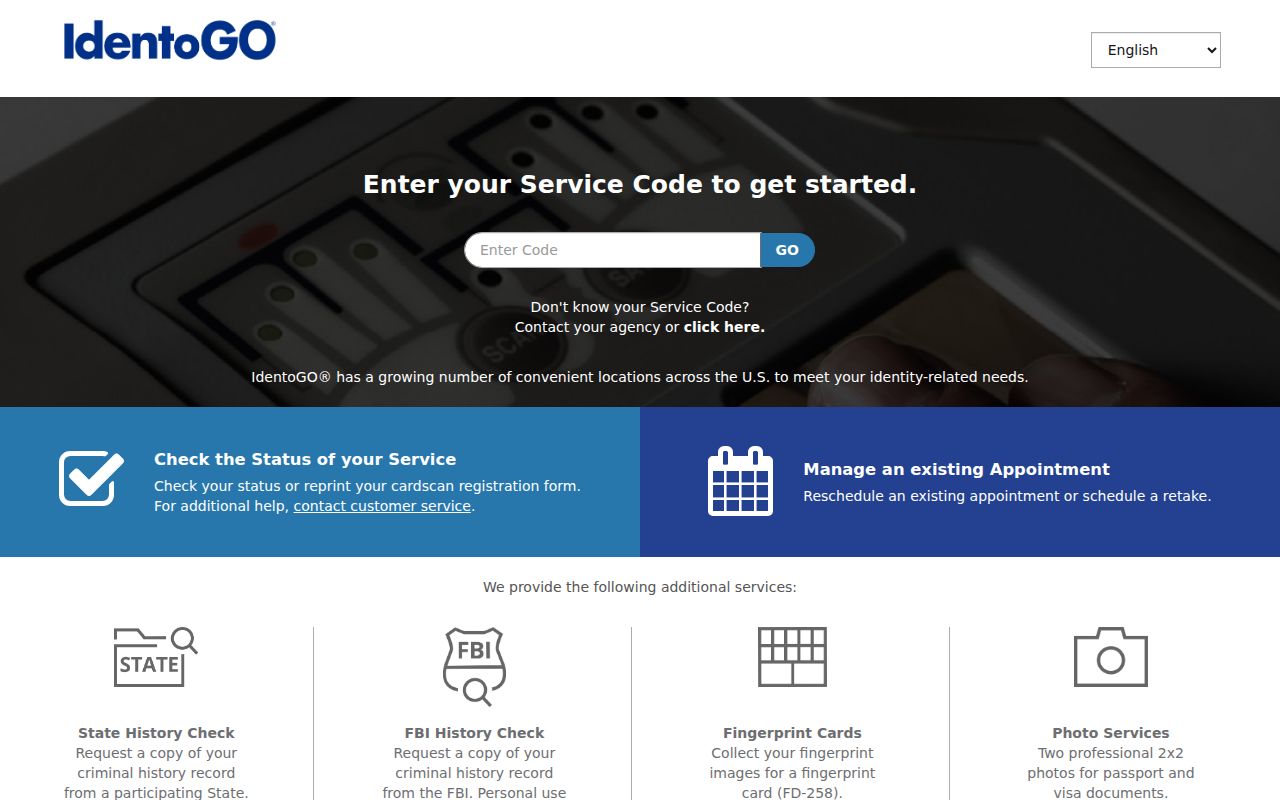
The enrollment screen is the proper place to confirm the site and transaction before travel. Once the personal review identifies the wrong arrest cycle or missing outcome, contact the agency or court that owns the source record and DPS. The state repository cannot create a judgment that the clerk has not reported.
Sealed, Expunged, and Restricted Records
Texas expunction and nondisclosure are different remedies. Chapter 55 expunction can direct removal or destruction of qualifying arrest records. Eligibility can arise from certain acquittals, pardons, identity errors, no-bills, dismissals after statutory requirements, and specified Class C outcomes. It is not automatic merely because a charge was dismissed. For a Zapata County arrest, confirm venue and procedure with the District Clerk. No local petition packet or filing fee was published.
A nondisclosure order restricts public release of qualifying criminal-history information but preserves access for criminal justice and other listed governmental recipients. Juvenile records follow separate Family Code rules. Victim data, financial identifiers, medical facts, and sealed material also remain outside a public search. After any relief order, keep certified copies, allow agencies time to process it, and use a fingerprint personal review to check the state record.
| Feature | Expunction | Nondisclosure |
|---|---|---|
| Main effect | Removal or destruction of qualifying arrest records | Restriction of qualifying public criminal-history disclosure |
| Government access | Narrow statutory exceptions | Criminal justice and listed agencies retain access |
| Typical filing path | District court venue set by Chapter 55 | Court handling the qualifying case as the statute directs |
Zapata County State and Federal Records
The Rio Grande, Falcon International Reservoir, U.S. Highway 83, and ranch land create overlapping record paths. The sheriff, DPS Highway Patrol, Texas Parks and Wildlife wardens, Border Patrol, Homeland Security Investigations, DEA, or another federal agency may take part in one event. State charges stay in Zapata County courts. Federal border, immigration, firearms, narcotics, and public-corruption cases can appear in the Southern District of Texas instead.
Agency identity is the first sorting fact. A DPS traffic stop can create a state crash report and a Zapata County criminal cause. A federal arrest can produce an agency report, a federal detention order, and a PACER docket without any matching county cause. Falcon Lake activity may begin with a game warden, while the later charge belongs in state or federal court. Ask who made the arrest, who accepted the charge, and which custodian now holds the document. That short chain prevents a broad county search from missing a record that was never filed in Zapata County's local system.
Use PACER for a federal docket and the BOP locator for sentenced federal custody. A newly arrested federal defendant may not yet appear in BOP. For state court activity, the Texas Office of Court Administration statistical reports supply official court-level counts when the fiscal year and court type are stated.
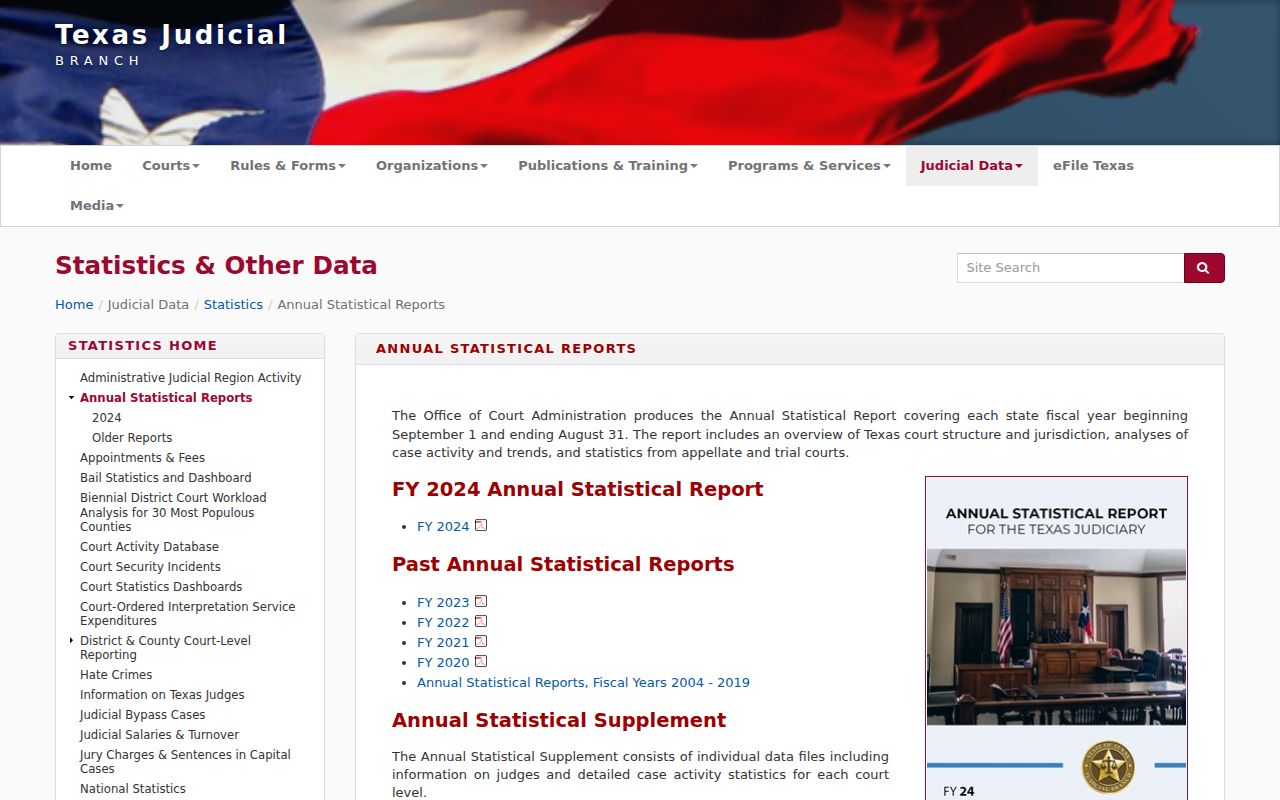
The reports shown above provide context, not a name-based criminal case lookup.
Zapata County Supervision Records
Adult community supervision is handled through the Webb, Zapata and Jim Hogg Counties Community Supervision and Corrections Department structure. The county directory lists Adult Probation at the courthouse, 956-765-9936. A court judgment and docket are the public starting points for whether supervision was ordered. Officer notes, treatment, tests, residence, and detailed supervision plans are not a public online lookup.
Parole is state-run. The Texas Board of Pardons and Paroles makes release decisions, while the TDCJ Parole Division handles field supervision. The official TDCJ county directory assigns Zapata County to the Laredo District Parole Office in Region IV.
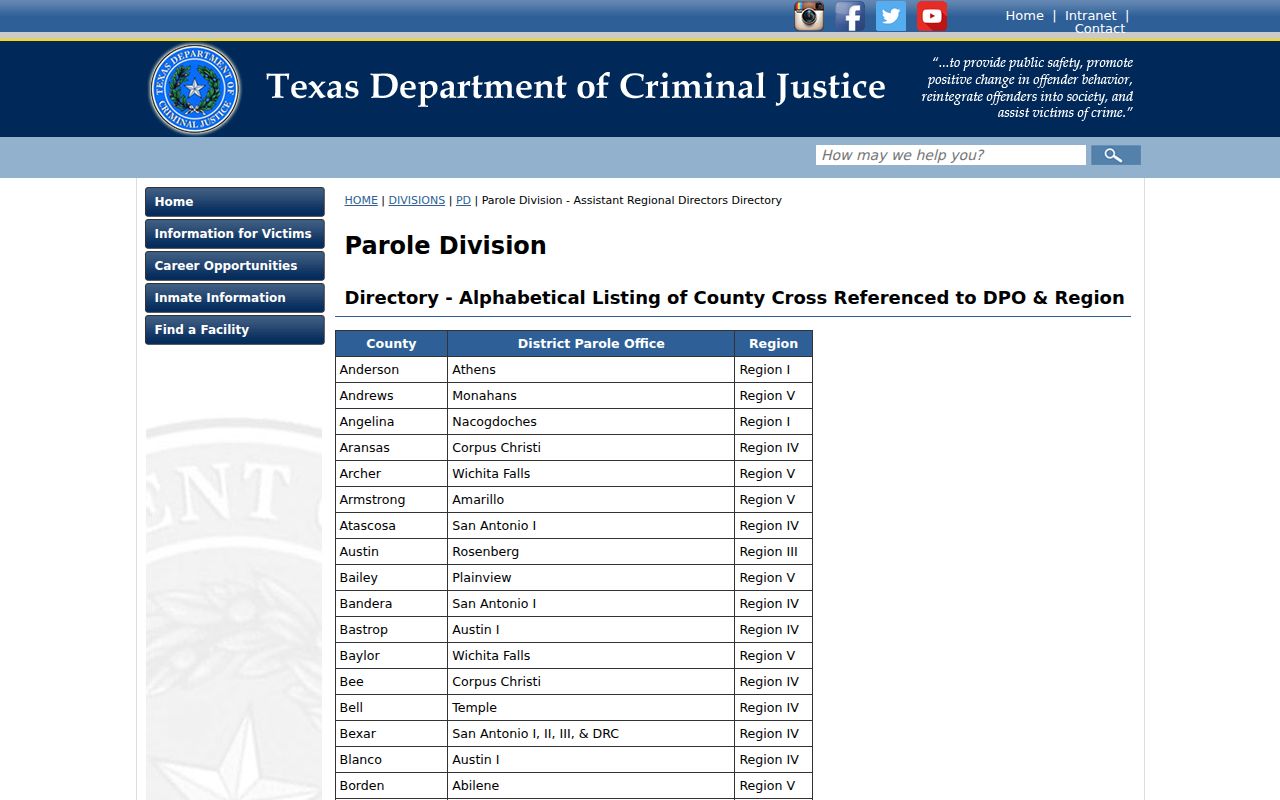
The directory helps route a lawful status inquiry, while the court judgment remains the source for the original sentence.
Criminal Records by City in Zapata County
Zapata County has no incorporated city, town, or village. Zapata, San Ygnacio, Falcon Lake Estates, Falcon, Las Palmas, and Medina are census-designated places or unincorporated communities. A CDP is a statistical area, not a municipal government. It therefore has no city police department or municipal court merely because it has a place name. Residents use the Zapata County Sheriff, county clerks, 49th District Court, County Court, and JP courts. San Ygnacio also routes fine-only matters through JP Precinct 2. No city criminal-history guides are published because creating them would imply agencies that do not exist.